
BOOKS

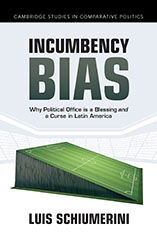
Incumbency Bias: Why Political Office is a Blessing and a Curse in Latin America

2025. Cambridge University Press. Cambridge Studies in Comparative Politics Series.

Awards: Robert A. Dahl Award, American Political Science Association; Best Book Award, Subnational Politics Section, Latin American Studies Association; Honorable Mention, Economics and Politics Section, Latin American Studies Association.

"This is, by far, the best book I have read on the comparative politics of incumbency.  A must-read for anyone who studies—or cares about—electoral politics in Latin America"

Steven Levitsky, David Rockefeller Professor of Latin American Studies and Professor of Government, Harvard University

Reviews: Latin American Politics and Society; Latin American Public Opinion Journal.
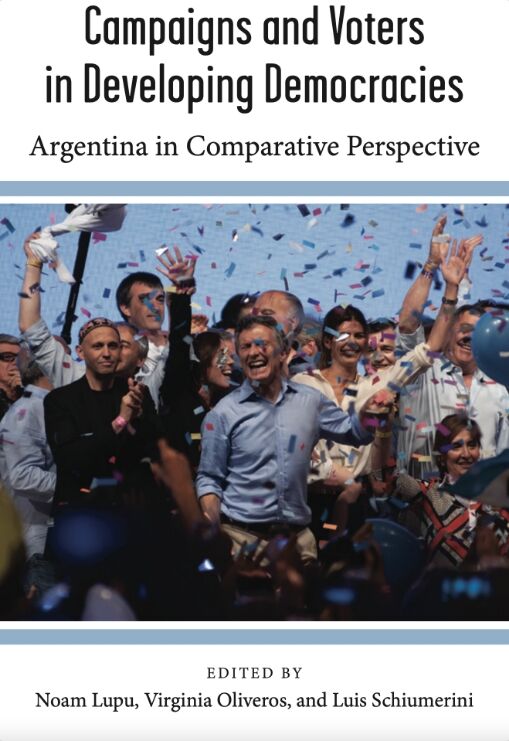
Campaigns and Voters in Developing Democracies: Argentina in Comparative Perspective

2019. Ann Arbor: University of Michigan Press (co-edited with Noam Lupu and Virginia Oliveros)  

"An essential book in understanding voters’ choices, political elites’ behavior, and political parties in contemporary Argentina"

Agustina Giraudy, Professor of Political Science, American University

Reviews:
Perspectives on Politics, Latin American Politics and Society, Revista SAAP and PostData

JOURNAL ARTICLES
BOOK CHAPTERS
WORKING PAPERS

Affective Polarization Without Partisans: Social Identity Versus Policy Preferences in Argentina

(with Noam Lupu and Virginia Oliveros)

What drives affective polarization in democracies with weak partisan attachments? Against the view that partisan animosity reflects deep-seated intergroup hostility, we argue that policy disagreement is the primary driver. Three survey experiments and a decade of longitudinal data from Argentina show that policy information substantially reduces the effect of partisanship on interpersonal affect, while social information does not, even after the emergence of a far-right party that explicitly employs polarizing rhetoric.

Campaigns, Learning, and Political Knowledge

(with Noam Lupu)

Political knowledge is critical if citizens are to select and sanction their representatives, but where does that knowledge come from? We argue that election campaigns are an understudied source, particularly where the political landscape is unstable, and test the argument using original panel election surveys from Argentina and Costa Rica.

After Autocracy: Civil Liberties, Collective Memory, and Democratic Commitment

(with Scott Mainwaring)

Why does democratic commitment run deep in some post-authoritarian countries and remain shallow in others? We argue that commitment rests on citizens’ beliefs about democracy’s superiority in protecting civil liberties, forged through exposure to state violence and collective memory. Evidence from 17 Latin American countries, together with original panel surveys and experiments in Argentina, Brazil, Chile and Mexico (N = 8,102), shows that the belief that democracy far outperformed the authoritarian past in protecting rights is the best predictor of democratic support: commitment follows citizens’ beliefs about rights, not their beliefs about growth.

WORK IN PROGRESS

To Pool or not to Pool? Estimating Incumbency Bias with Close-Election RDD in multiparty systems

(with Marinho Bertanha and Jeff Harden)

Close-election regression discontinuity designs identify incumbency effects cleanly in two-party systems, but multiparty elections force analysts to decide how to pool parties around the discontinuity, and different choices imply different estimands. We evaluate alternative estimators within a structural econometric model and derive guidance on when pooling is warranted.

Does Depolarization Start at Home? How Foreign Threats and Elite Cues Affect Compromise in the United States

(with Geoff Layman and Joe Parent)

Does external threat soften partisan hostility at home? Drawing on survey experiments with nearly 10,000 respondents, we test whether foreign threats and cues from party leaders make Americans more willing to accept political compromise.

Do Elites Support Democracy?  Experimental Evidence from a Survey of Argentina Members of Congress

(with Sandra Botero, Carlos Gervasoni and Scott Mainwaring)

Surveys of political elites rarely capture genuine commitment to democracy, because legislators know which answers are expected of them. We survey Argentine national legislators using both direct and indirect questioning, including list experiments designed to mitigate social desirability bias.

OTHER WRITING

How Beliefs about Regime Performance Shape Democratic Attitudes (Forthcoming)

(with Scott Mainwaring)

AmericasBarometer Spotlight, Pulse of Democracy series, Latin American Public Opinion Project, Vanderbilt University.

El Efecto Cancha Inclinada: Ventaja del Oficialismo en las Provincias Argentinas (An Uneven Playing Field: Incumbency Advantage in Argentina) (2012)

Public Policy Memo, Argentine Center for the Implementation of Policies for Growth and Equity. (with María Page.)  Media coverage (Clarín, La Nación).

Apoyo Ciudadano a la Democracia en América Latina (Citizen Support for Democracy in Latin America) (2021)

DP Enfoque 8. Konrad Adenauer Stiftung Foundation, Montevideo, Uruguay.